Three captured light states
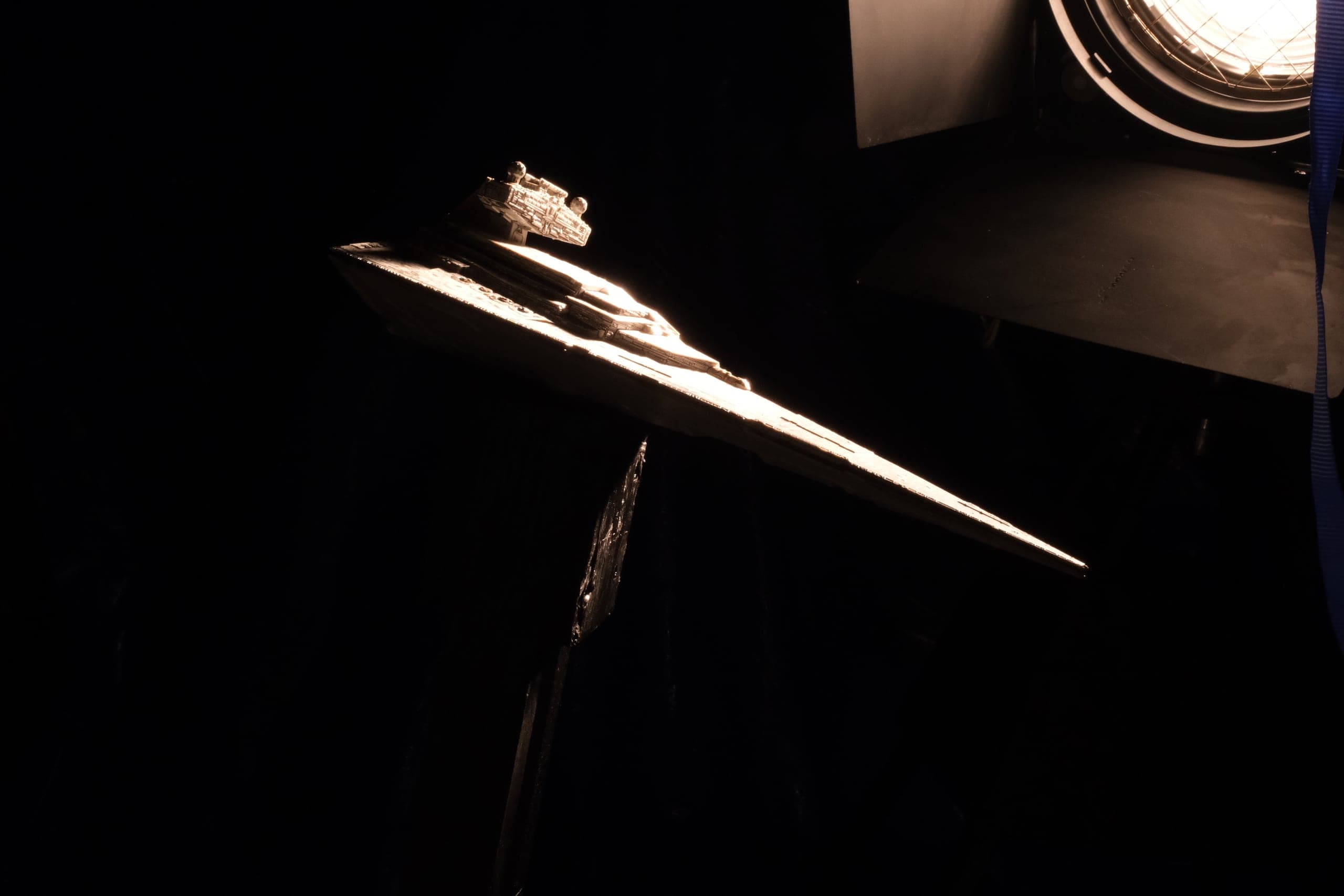
Key, practicals and engine glow were photographed in separate passes with exposure, white balance and focus locked.
A physical object becomes a navigable world without surrendering the material and light that made it believable.
ALIVE — Actual Light In Virtual Environments — tests whether the physical truth of a miniature can survive reconstruction, camera movement and a live-action composite. The chain is only as convincing as its weakest hand‑off.
Key, practicals and engine glow were photographed in separate passes with exposure, white balance and focus locked.
From one test viewpoint, the reconstructions stayed close enough to switch between states. Dark-pass noise and floaters remain.
A greenscreen performance must follow the calibrated digital path and hold up through lens match, occlusion, light and final comp.
Stone, cloth, resin, metal and miniature sets begin as real objects. Surface response and imperfection are photographed, not invented after the fact.
The object is lit as a miniature stage. Separate practical lighting states preserve the decisions made in front of the camera.
An eight-axis motion-control system is built to repeat camera movement and coverage precisely across multiple passes.
Gaussian splatting turns the photographs into a navigable record of the real object — material, light and all — ready to be scaled and assembled into a world.
The next proof places a motion-controlled greenscreen performance inside the captured world, then finishes the shot in Nuke with matched lens, timing, grain and light.
The motion-control path becomes the common coordinate system between workshop, Blender and greenscreen stage.
Miniature. Camera move. Performance. Final frame.